

Every January, gyms fill up with people training like Olympians. By March, most are gone. The ones still there in December are rarely the ones who went hardest in week one. They’re the ones who decided Tuesday at 7am is when they train, whether they feel like it or not.
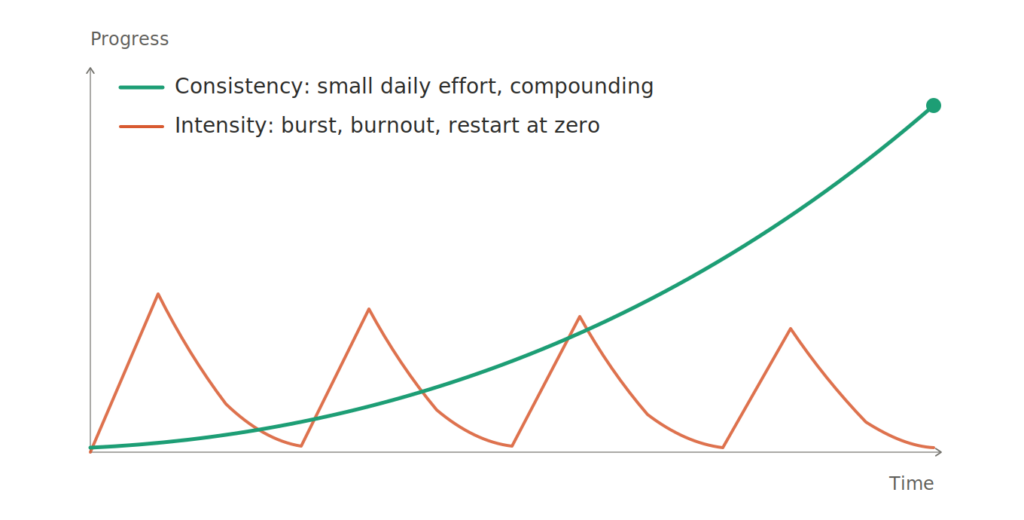
The same pattern holds beyond fitness. Writers who finish books wrote most days for years. Language learners did fifteen minutes daily, not one heroic Saturday followed by nothing. Intensity feels productive because it produces visible suffering, and we mistake suffering for progress. But goals that take years don’t respond to bursts. They respond to showing up.
What the science says
In 2010, Phillippa Lally and her colleagues at University College London tracked 96 people building a new daily habit. Habits took an average of 66 days to become automatic, and some took over 200. More encouraging: missing a single day made no measurable difference. What killed habit formation wasn’t imperfection but extended gaps. One skipped day costs nothing. Two in a row, repeated often, is how habits die.
Angela Duckworth’s research at the University of Pennsylvania points the same way. Studying West Point cadets, she found that grit, her measure of sustained persistence toward long-term goals, predicted who survived the brutal first summer better than the academy’s own admissions score. Her explanation: effort counts twice. It builds skill, then applies it. The intense-but-inconsistent person keeps restarting at zero on both.
A third study shows the mechanism. In 2002, Milne, Orbell and Sheeran motivated one group of people to exercise. A second group got the same motivation but also wrote down exactly when and where they would work out. In the motivation-only group, 35 percent followed through. In the group with a plan, 91 percent did. Motivation, the fuel of intensity, barely moved behavior. A boring, specific commitment nearly tripled it.
Two lives built on repetition
Anthony Trollope worked full time at the British postal service. He wrote before work each morning, tracking himself at 250 words per quarter hour, and if he finished a novel mid-session he simply started the next one. No inspiration, no binges. He produced 47 novels, more than almost any major novelist in English.
Jerry Seinfeld’s version is famous among writers. Asked how to get better, he reportedly told a young comedian to write jokes daily, mark each day with a red X on a wall calendar, and then guard the chain. The trick isn’t the calendar. It redefines success from “write something brilliant,” which you can’t control, to “show up today,” which you always can.
How to apply it
For personal goals, shrink the daily unit until it’s almost embarrassing: ten minutes of French, one page of the book. It has to fit your worst day, because your worst days are when the habit is decided. Give it a fixed time and place, since “Monday at 6:30 before breakfast” survives low motivation and “I’ll exercise more” doesn’t. Then follow the two-day rule: missing once is noise, missing twice starts a new pattern.
At work, the goal that matters most usually has no deadline, so urgent things eat it. Block the first 45 minutes of your day for it before email opens. That’s nearly four hours a week, and it compounds. And measure inputs, not just outcomes: you can’t control this month’s revenue, but you can control ten customer calls a week.
Consistency wins because it’s the only strategy that survives an ordinary life. Intensity needs ideal conditions, and those are rare. A small daily action fits into sick days and busy seasons. It doesn’t need you at your best, just there. Pick your goal, find its smallest daily unit, and protect it for 66 days.
This is exactly what GoalsOnTrack is built for. You can break a big goal into small daily tasks, track your habits with streaks so you can see the chain grow (and notice before you miss twice), and use the built-in time tracker to protect that daily block of focused work. Set up your first habit at GoalsOnTrack.com and let the software remember so you only have to show up