
We are often told that to achieve our goals, we need to work hard, stay focused, and never give up.
But is that always good advice?
What if you’ve been working on a goal for years and still don’t see much progress? What if you’re making good progress, but you don’t enjoy the work you’re doing?
Should you keep going, or is it time to let go?
The problem is that we often become so attached to our goals that we stop questioning whether they’re still worth pursuing. We feel that giving up means failure, especially after investing so much time and effort. So we keep pushing ourselves, even when the goal no longer makes sense.
On the other hand, we don’t want to quit too early and miss out on something that could have been worthwhile.
How do we find the right balance?
This is where the idea of non-attachment comes in.
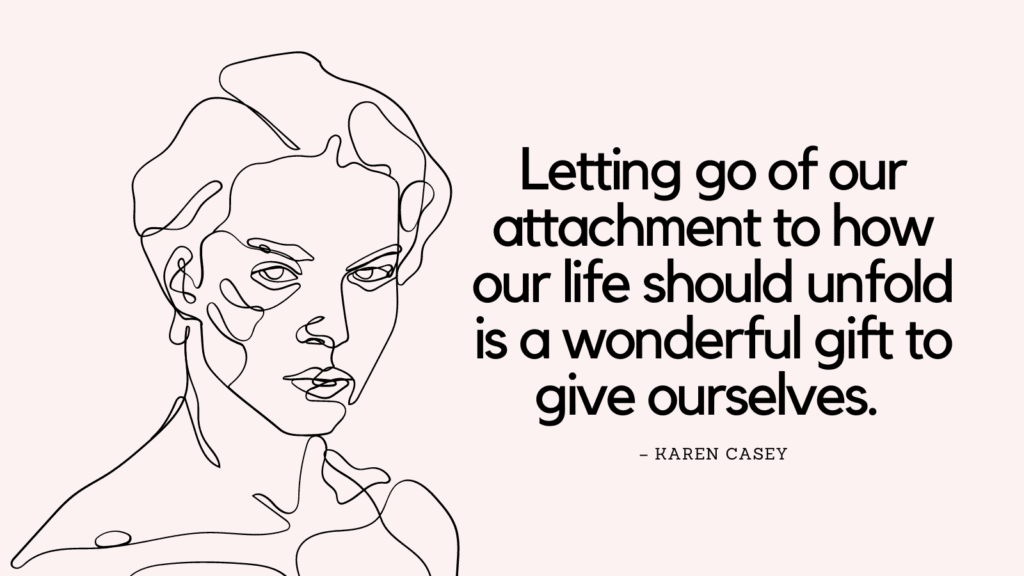
Non-attachment means you can care deeply about your goals without being too attached to the results. You still work hard and do your best, but you don’t let success or failure determine your happiness or self-worth. More importantly, you’re willing to step back, question your approach, and change direction when necessary.
In other words, work hard toward your goals, but don’t hold on to them too tightly.
Focus on What You Can Control
Imagine you’re trying to build a successful business. You’ve set a goal to earn $10,000 a month.
If you’re too attached to this goal, you may feel disappointed every month you don’t reach that number. Even if your business is growing, you may still feel like you’re failing.
But what if you focus more on what you can do each day?
You can improve your product, talk to customers, try new marketing ideas, and learn from your mistakes. You can’t always control how much money your business makes, but you can control many of the actions that help it grow.
Take J.K. Rowling, the author of Harry Potter.
Before her first Harry Potter book was published, her manuscript was rejected by several publishers. She was also going through a difficult time in her personal life.
But she kept writing and trying to get her book published. Eventually, Bloomsbury accepted her manuscript in 1996, and the book came out the following year.
Sometimes we need to keep going even when things don’t work out as expected. A few setbacks don’t necessarily mean we’re on the wrong path.
The important thing is to keep learning and improving, rather than letting every failure discourage us.
What If You’re Not Making Progress and Don’t Enjoy the Work?
Now imagine you’ve been working on a goal for a long time. You’re not seeing much progress, and you don’t enjoy the work either.
Should you just keep pushing yourself?
Probably not.
I think there are three main reasons why we keep working toward a goal.
We may enjoy the work itself. We may be motivated by the progress we’re making. Or we may believe the goal is important enough that we’re willing to do some unpleasant work to achieve it.
You don’t need all three reasons to keep going.
For example, you may not enjoy exercising, but you can see yourself getting stronger and healthier. That’s a good reason to continue.
Or you may enjoy learning to play the piano, even if you’re improving very slowly.
But what if you don’t enjoy the work, don’t see progress, and aren’t even sure whether the goal is worth the effort anymore?
Perhaps it’s time to stop and think.
Maybe you need a different approach. Maybe you need a break. Or maybe the goal is no longer right for you.
There’s nothing wrong with changing your mind. Non-attachment means being willing to let go of a goal or strategy when it no longer serves you, rather than continuing simply because you’ve already invested so much in it.
What If You’re Making Progress but Don’t Enjoy the Process?
This is another interesting situation.
Let’s say you’re making steady progress toward your goal. Everything seems to be working, but you really don’t enjoy the daily work.
Should you continue?
Well, it depends.
Some goals require us to do things we don’t like. Students may not enjoy studying for exams. Athletes may not enjoy every training session. Business owners may dislike dealing with paperwork or customer complaints.
But they keep going because the results are worth the effort.
The question is, how long will you have to do this unpleasant work?
If you only need to do it for a few months to achieve something important, perhaps it’s worth it.
But what if you have to keep doing it for the next ten or twenty years?
Imagine you spend ten years building a successful business, only to find that running it requires you to spend every day doing work you dislike.
Is that really the success you wanted?
Before giving up, see if you can change the way you work. Can you automate some tasks? Hire someone to help? Find a simpler or more enjoyable way to get the same results?
Sometimes you don’t need to change your goal. You just need to change how you pursue it.
Non-attachment allows you to make that choice freely, without feeling that you must stick to your original plan simply because it’s producing results.
Know When to Keep Going and When to Let Go
In 1985, Steve Jobs was forced out of Apple, the company he helped start.
For many people, losing control of the company they built would have been the end of their dream.
But Jobs didn’t stop working on what he loved.
He started another computer company called NeXT and became involved with Pixar. Years later, Apple bought NeXT, and Jobs returned to Apple.
In his 2005 Stanford commencement speech, Jobs said that being fired from Apple turned out to be one of the best things that could have happened to him.
Sometimes losing one opportunity can lead to something even better.
The key is to know the difference between your goal and the way you’re trying to achieve it.
Perhaps your real goal is financial freedom. Building a successful business is just one way to get there.
If your business isn’t working out, you can try a different business, find a better job, or pursue another source of income.
You don’t have to give up financial freedom just because one approach didn’t work.
This is another important part of non-attachment: staying committed to what matters to you while remaining flexible about how you get there.
A Simple Framework to Decide What to Do Next
Non-attachment doesn’t mean making decisions based on how you feel on any particular day. It means being able to look at your goals more objectively, without letting fear of failure or past investments cloud your judgment.
When you’re unsure whether to continue pursuing a goal, try asking yourself these four questions.
1. Does this goal still matter to me?
Think about why you wanted to achieve it in the first place. Does it still fit your values and the life you want?
If the answer is no, perhaps it’s time to let it go. There’s no reason to keep chasing something just because you once wanted it.
2. Am I making meaningful progress?
Look at the results, not just how much effort you’ve put in.
Are you getting closer to your goal? If not, is there a good reason to believe your efforts will eventually pay off?
Sometimes progress is slow, but still real. Other times, we’re simply repeating activities that don’t work.
3. Is the effort worth it?
Think about the time, energy, money, and happiness you’re spending on this goal.
Do you enjoy the work? If not, are the results important enough to make the effort worthwhile?
You don’t have to love every step, but the cost shouldn’t be greater than the value you’re getting.
4. Is there a better way to achieve the same goal?
Before giving up, consider whether you could change your approach.
Could you simplify the work, get help, learn a new skill, or try a different strategy?
Sometimes a small change can make a big difference.
Once you’ve answered these questions, you can choose one of four paths:
| Decision | When it makes sense |
|---|---|
| Persist | The goal matters, you’re making progress, and the effort is worth it. |
| Pivot | The goal matters, but your current approach isn’t working or is too costly. |
| Pause | You’re exhausted, uncertain, or need time to rethink your options. |
| Quit | The goal no longer matters enough, or its costs outweigh its benefits with no reasonable path forward. |
You don’t have to make a permanent decision right away.
If you’re unsure, give yourself another 30 days to test a different approach. Set a small, measurable target and see what happens.
For example, if you’re trying to grow a business, instead of simply working harder, you might test one new marketing strategy for a month and measure whether it brings in more customers.
At the end of the month, review the results and decide whether to continue, change direction, or stop.
The important thing is to make a conscious decision rather than continuing out of habit or quitting out of frustration.
Don’t Let Your Goals Control Your Life
There’s one more thing we should think about.
Why do we set goals in the first place?
Usually, it’s because we believe achieving them will make our lives better. We want more freedom, better health, stronger relationships, or a greater sense of accomplishment.
But sometimes we become so busy chasing our goals that we forget why we wanted them.
We sacrifice our time, health, and happiness to reach a destination that may not even make us happy when we get there.
That’s why it’s important to ask yourself from time to time:
Is this goal still important to me? Am I making meaningful progress? Is the effort worth it? Will achieving this goal really make my life better?
If the answers are yes, then keep going.
If not, perhaps something needs to change.
Non-attachment doesn’t mean you shouldn’t have big dreams or work hard to achieve them. It simply means you should be willing to change direction when necessary.
You can be ambitious without being obsessed. You can work hard without making yourself miserable. And you can let go of a goal without feeling like a failure.
After all, your goals are supposed to help you build a better life, not make your life harder.
So, are you pursuing your goals, or are your goals controlling you?